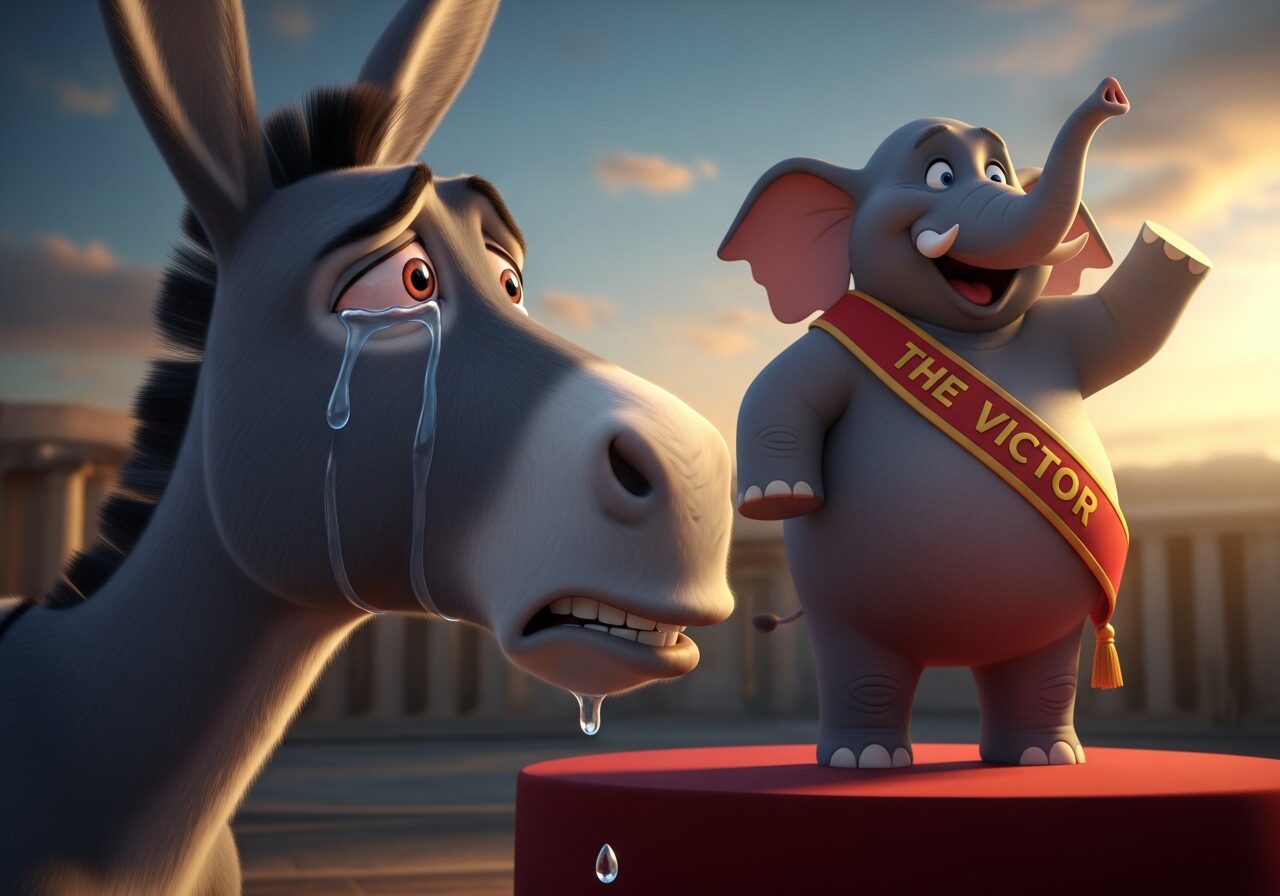
Democrats have spent the last three months measuring the drapes in the Speaker’s office. The media declared the “blue wave” a foregone conclusion back in January. Prediction markets gave Democrats a 71% chance of sweeping the House. There was just one small problem — nobody told the voters.
Whoops!
A brand-new Harvard CAPS/Harris poll of 1,999 registered voters just found the 2026 midterm generic ballot sitting at a perfect 50-50 dead heat. Republicans. Democrats. Tied. Done. In January, Democrats led that same poll 54% to 46%. That’s an eight-point lead that evaporated in a single month — like a puddle on a Phoenix sidewalk in July.
Here’s what makes this truly delicious. Remember 2018? That was the last time Democrats actually got their precious “blue wave.” In March 2018, Democrats held roughly an eight-point lead on the generic ballot. And guess what happened in November? They won the national House popular vote by 8.6 points and picked up 40 seats. The polling held. The lead was real. The wave delivered.
In 2026, Democrats had the same eight-point lead — and it didn’t hold for 30 days. Let that sink in.
The data gets worse for the Resistance crowd when you dig into the details. After President Trump’s State of the Union address, 51% of voters said they were MORE likely to vote Republican for Congress. Every single one of the 11 new policies Trump announced during the speech received majority support from voters. Every. Single. One. The most popular? Lowering prescription drug prices at 80% and deporting criminal illegal aliens at 75%.
Meanwhile, only 33% of voters even bothered to watch Governor Abigail Spanberger’s Democratic “rebuttal” from Colonial Williamsburg. (Colonial Williamsburg! Nothing says “we’re the party of the future” like delivering your message from an 18th-century theme park.) Fifty-two percent of voters thought the Democrat boycott of the speech was “appropriate” — but 57% said the booing and jeering from the Democrats who DID show up was “out of line.”
Think about that math for a second. Half the Democrats boycotted and held a “People’s State of the Union” on the National Mall — which sounds like something a college sophomore would organize after reading their first Noam Chomsky book. The other half showed up and acted like rowdy middle schoolers on a field trip. Rep. Al Green got himself escorted out of the chamber for waving a protest sign. Rashida Tlaib and Ilhan Omar couldn’t stop themselves from heckling. (Shocked. We are absolutely shocked.)
And voters noticed.
This is the part nobody in the Democrat war rooms wants to hear: the boycott strategy didn’t hurt Trump. It hurt Democrats. When you walk out of the room, you don’t get to shape the conversation. You just look like you can’t handle being in it. Fifty-seven percent of American voters watched Democrats jeer and boo on national television and said, “That was out of line.” Those are your swing voters telling you they’re embarrassed for you.
And the economic numbers are burying the narrative even deeper. Fifty-two percent of voters now say the economy is better under Trump than it was under Biden — that’s up five points from just January. Fifty-one percent say the economy is currently strong, up a staggering eight points since November 2025. Trump’s net approval improved from minus-6 to minus-3 in a single month. Not great numbers in isolation, but the trajectory is a freight train headed in the wrong direction if you’re a Democrat strategist.
The Republican campaign message — “returning responsibility to government by arresting criminals, closing the borders, keeping taxes low” — tested at 54% credibility with voters. The Democrat message? Forty-eight percent. When your opponent’s pitch is more believable than yours by six points, you don’t have a messaging problem. You have a reality problem.
Here’s where this is going, and you can mark my words on this one.
The generic ballot doesn’t just “stabilize” at 50-50 eight months out. It moves. And every historical precedent tells us which direction it moves in a midterm year: toward the out-party’s initial position IF the fundamentals support it, or toward the president’s party when the economy is improving and the opposition is busy setting itself on fire.
In 2010, the generic ballot swung hard toward Republicans all year long. Obama’s approval sat around 45%. The GOP won the popular vote by 6.8 points and gained 63 seats — the biggest swing since 1948. In 2018, Democrats built their lead early and held it because Trump’s approval was underwater AND the economy wasn’t giving voters a reason to stick with Republicans.
In 2026? Trump’s approval is climbing. The economy numbers are improving month over month. And Democrats just spent their biggest national television moment of the year either boycotting the speech or heckling it. They chose performative protest over persuasion — and the polling shifted eight points against them in a single month.
The 2018 blue wave had real, sustained, building momentum behind it. This one? It crested in January and collapsed before spring. Democrats needed their 2026 generic ballot lead to be 2018 — steady and growing. Instead, they got 2010 in reverse. The wave is running out to sea, and they’re still standing on the beach with their surfboards.
Prediction markets still have Democrats at 71% to take the House. Those prediction markets also had Kamala Harris at 95% to be the Democrat nominee back when Joe Biden was still pretending he could find the Oval Office. Smart money should start looking at the trendline, not the January snapshot.
Democrats don’t need a wave. They only need three seats to flip the House. But when your eight-point lead vanishes in 30 days, you’re not riding a wave anymore. You’re treading water. And we’re only in March.
Grab the popcorn. This is going to be a fun eight months.