
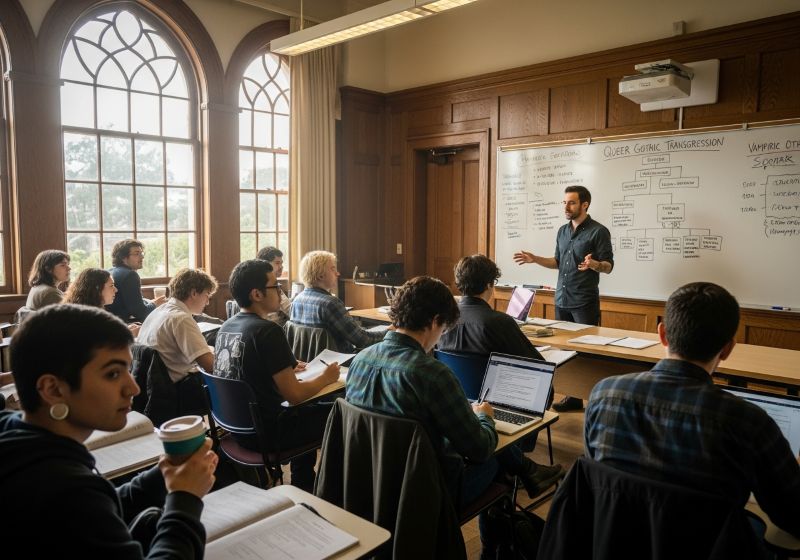
UC Berkeley — an institution that somehow still has a reputation as one of the finest public universities in the world — has decided that final exams are too old-fashioned for the modern scholar. Professor Juana Maria Rodriguez now has students in her “Queer of Color Critique” course skip the final and instead edit Wikipedia articles about queer vampires.
That’s not a typo. The final exam has been replaced by Wikipedia edits about vampires. Queer ones.
Rodriguez teaches in Berkeley’s Ethnic Studies department and has been running this operation since 2016, when she decided the best way to “resist” Donald Trump was to have college students add citations to Wikipedia pages about “LGBTQ themes in horror fiction,” “gay characters in telenovelas,” “indigenous drag performers,” and the crown jewel of the collection — “queer vampires.” Because when fascism is at the door, the only thing standing between us and tyranny is a well-sourced Wikipedia article about Nosferatu’s love life.
Her students have collectively made over 300,000 edits and added 3,000 citations to these articles, generating nearly 100 million Wikipedia views. This isn’t a quirky class project. It’s an industrial-scale information operation disguised as coursework. A professor at a taxpayer-funded university is using students as unpaid Wikipedia editors to push ideological content onto the world’s most-visited reference site — and calling it a final exam.
Rodriguez, by the way, is the author of Puta Life: Seeing Latinas, Working Sex. Her research specialties include “racialized sexuality” and “queer of color theory and activism.” She’s won a Distinguished Teaching Award at Berkeley. This is what passes for distinguished teaching in 2026.
Out-of-state students pay up to $75,000 a year for this experience. In-state students get a deal — their California tax dollars just subsidize it directly. Either way, someone is paying real money for students to edit Wikipedia instead of taking a real exam. Your parents remortgage the house. You edit a Wikipedia page about lesbian bars. Congratulations, graduate you’re ready for corporate American for sure now.
Here’s the thing about universities that become national punchlines: they don’t recover.
Ask Evergreen State College. In 2017, Evergreen became the poster child for campus wokeness run amok after students demanded a professor be fired for refusing to leave campus on a race-based “Day of Absence.” What happened next? Enrollment cratered 27% — a thousand students vanished. The school had to slash $6 million from its budget, lay off faculty, and completely overhaul its academic programs. Seven years later, they still haven’t recovered. The brand is permanently radioactive.
Or ask Oberlin College. After the school’s administration helped students wage a defamation campaign against a local bakery — accusing the owners of racism for catching a student shoplifting — a jury slapped Oberlin with a $36.59 million judgment. Enrollment had already been sliding. After the verdict, the credit agencies downgraded Oberlin’s outlook to negative. They’re still bleeding students.
Now look at UC Berkeley with its “Queer Vampires” final exam. Berkeley is a much bigger ship than Evergreen or Oberlin, so it won’t sink as fast. But the pattern is the same: a university becomes a national joke, and the damage compounds over years, not days.
And the timing could not be worse for universities hell bent on teaching woke. Defense Secretary Pete Hegseth just cut Pentagon ties with 22 elite universities for “woke indoctrination” — pulling tuition assistance and fellowship funding. Berkeley isn’t on that list yet. But when federal agencies start compiling lists of universities engaged in ideological activism instead of education, you think the school where the final exam is “edit Wikipedia about queer vampires” is going to slip under the radar? (Spoiler: no.)
Mark my words — within two years, Berkeley’s Ethnic Studies department is going to become Exhibit A in every federal defunding argument. Not because one professor did something silly, but because the university celebrated it. Berkeley’s own news site published a glowing feature calling this “Wikipedia as resistance.” They gave Rodriguez a teaching award. The institution didn’t just tolerate this — they put it on a billboard.
The real second-order effect nobody’s talking about: those 300,000 Wikipedia edits. Wikipedia is supposed to be a neutral encyclopedia. But when a university professor assigns students to systematically add ideological content — on queer vampires, transgender asylum seekers, “indigenous drag performers” — at industrial scale, Wikipedia’s neutrality becomes a casualty. And once people notice that Wikipedia has been turned into a homework assignment for activist coursework, the platform’s credibility takes a hit too. Rodriguez isn’t just embarrassing Berkeley. She’s eroding trust in the reference source that half the internet relies on.
Can you imagine the parent who writes a $75,000 check and finds out their kid’s final exam was editing a Wikipedia article about queer vampires? That parent is not writing that check again next year. Multiply that by a few thousand, and you’ve got yourself an Evergreen situation.
Berkeley has survived a lot. But “Queer Vampires Wikipedia Final” is the kind of headline that sticks to a brand like garlic to a — well, you know.